
Motorcycle Goggles vs Sunglasses: Which Is Right for You?
This post contains affiliate links. As an Amazon Associate, we earn from qualifying purchases.
Motorcycle goggles are sealed eye protection designed for high-speed, off-road, or bad-weather riding. Motorcycle sunglasses are lightweight, wrap-around eyewear best for commuting, casual cruising, and are often recommended for use with a full-face helmet (TicketShield), though some sources note goggles may not fit under a full-face helmet’s shield (SportRx). Goggles win on total coverage and wind sealing; sunglasses win on convenience, breathability, and helmet compatibility.
That choice isn’t about looks. It’s a functional decision that changes based on your helmet, speed, and the weather you ride in, weighing the practical differences of motorcycle goggles vs sunglasses. A goggle that doesn’t fit your helmet’s eye port is useless, and sunglasses that leak wind at highway speeds will dry your eyes out in an hour.
What follows is the decision map the spec sheets won’t give you. We’ll match specific riding scenarios to the right eyewear type, break down the safety certifications that actually matter, and name the products that deliver on their claims.
Key Takeaways
- Choose motorcycle goggles for high-speed riding, off-road/adventure riding, or use with open-face helmets. Their seal blocks wind and debris that glasses can’t.
- Choose motorcycle sunglasses for daily commuting, short trips, or any ride where you wear a full-face helmet, as they are recommended for this use by TicketShield and typically fit under the shield and fog less at lower speeds.
- A recognized safety certification like ANSI Z87.1, EN 1938:2010, EN 166, MIL-DTL-43511D, or ASTM F803 is your baseline for impact protection. A product’s manual or spec sheet must name it.
- Never ride with non-safety-rated “fashion” sunglasses. Polycarbonate lenses and the ANSI Z87.1+ or EN 1938:2010 safety standard are essential for crash protection.
- Lens tint is separate from UV protection. A clear lens can block 100% of UV rays; a dark lens with no UV rating offers zero protection.
The Short Answer: Goggles vs. Sunglasses by Use Case
Forget “one is better.” Your riding style picks for you. The chart below locks the choice to five common scenarios. If your ride matches one, the answer is straightforward.
| Your Ride Looks Like This… | You Should Wear… | Why This Is The Rule |
|---|---|---|
| Highway commuting at high speeds, year-round | Goggles | Wind sealing at speed prevents dry-eye fatigue and keeps out road grit. |
| Weekend backroad cruising, frequent stops | Sunglasses | Better breathability means less fogging when you’re not moving. |
| Off-road or adventure riding (dirt, dust) | Goggles | The full foam seal stops fine dust that ruins vision and damages eyes. |
| City commuting with a full-face helmet | Sunglasses | They are recommended for this use by TicketShield and typically fit safely under the helmet’s closed visor without bulk. |
| Riding in rain, snow, or cold mornings | Goggles | The sealed frame keeps precipitation off the lens and your face. |
The logic is mechanical, not preferential. Goggles are a sealed system. Sunglasses are a filtered one. Your job when you compare motorcycle goggles vs sunglasses is to match the tool to the job the weather and your route will hand it.
Where this goes sideways: Buying goggles for a full-face helmet without checking the fit. The frame or outriggers can lever against the shell, breaking the seal at your brow and letting in a stream of dust. Test the fit before you commit.
How Safety Certifications Actually Work (And Which Ones Matter)
This is the part most riders glance over. You cannot see impact resistance. You have to trust the label, and not all labels mean the same thing.
The ANSI Z87.1 standard is the U.S. Benchmark for occupational eye protection. The “+” suffix denotes high-velocity and high-mass impact rating. The EN 1938:2010 standard is a European standard for motorcycle goggles, cited by SCOTT Goggles. If a product meets one of these, its lenses have been tested to withstand a specified impact. Some goggles, for example, meet ANSI Z87.1-2015 plus the military ballistic spec MIL-DTL-43511D.
Lenses are optically accurate. The lenses meet enhanced impact-resistance standards and withstand a blow of 60 m/s with a Ø 6 mm steel ball, at high and low temperature conditioning.
That 60 m/s test with a 6mm steel ball is from the SCOTT goggle manual. It’s a real, published threshold. A “shatter-resistant” claim on a gas-station pair has no such backing.
Here’s the honest take. ANSI Z87.1 certification is a great indicator that glasses meet or exceed basic safety requirements. It’s the floor, not the ceiling. Prescription lenses sold in the U.S. Must meet a separate FDA impact-resistance requirement, but that doesn’t make them “safety-rated” for a rock strike at highway speed. You need a recognized safety standard appropriate for the activity.
For activities with high impact risk, like motocross, some experts advise looking for ASTM F803-certified sports eye protectors as an alternative to ANSI Z87.1. The core principle is the same: a named, testable standard beats a marketing claim every time.
Helmet Compatibility: The Make-or-Break Fit Test
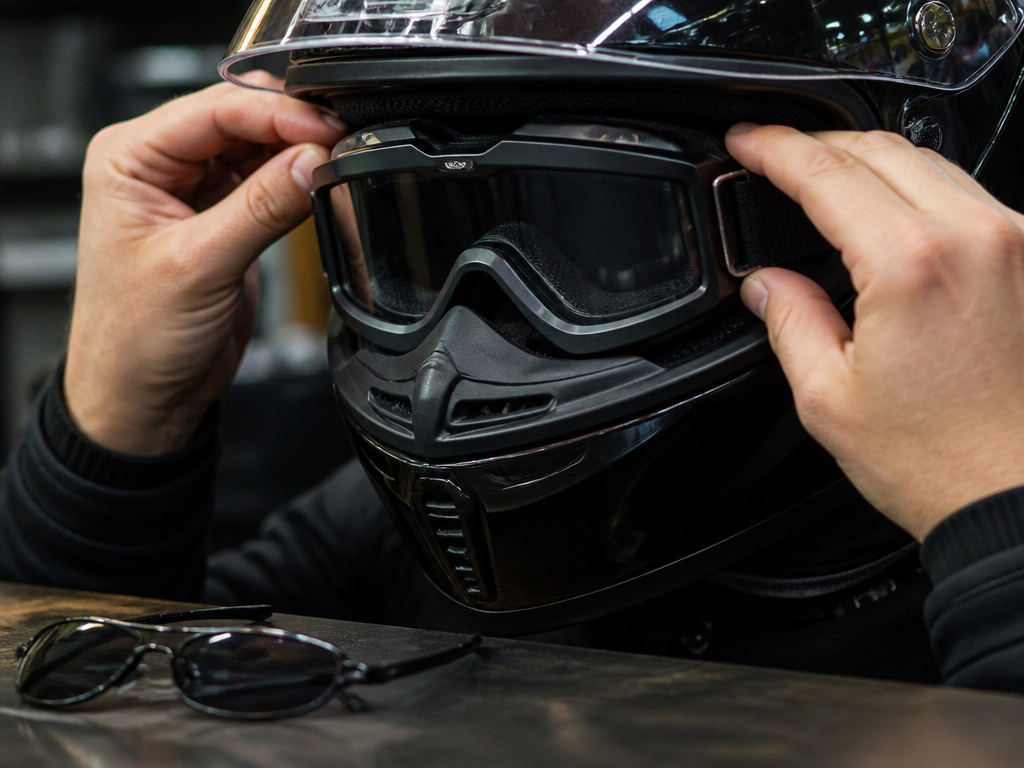
Your helmet picks your eyewear more than you do. This is the most common practical failure.
Full-face helmets lower the risk of facial injury by 66% compared to other types. Most are designed for a visor, not goggles. SportRx notes that goggles can be bulky and may not fit safely under a full-face helmet’s shield, making glasses the typical choice. The geometry is simple: if the goggle frame is wider than the helmet’s eye port, it won’t seat flush. You’ll get a gap at the top of your nose that funnels in wind and road noise.
Common mistake: Assuming all goggles fit all helmets. The outriggers on a motocross goggle are designed for a helmet with a peak. On a street helmet, they can press against the shell and tilt the whole frame off your face.
Open-face and half-helmets have no such barrier. Goggles are a natural partner here, and Liberty Sport states goggles are great for those who like open-faced helmets. The strap secures the goggles independently of the helmet, giving you a stable, sealed fit that sunglasses can’t match on a bare head.
The fix is to treat them as a pair. If you’re buying new motorcycle goggles, bring your helmet. Check that the goggles fit your helmet and face properly for a secure, sealed fit. For sunglasses, the test is whether the arms are slim enough to fit comfortably between your temples and the helmet’s padding without creating pressure points.
Wind, Weather, and Fogging: The Environmental Trade-Off

Your eyewear is a climate control system for your eyes. Goggles and sunglasses manage air and moisture in opposite ways.
Goggles seal. They have a foam or rubber gasket that presses against your face. This is fantastic for blocking wind. SportRx states that if you’re going to be riding at top speeds, you’ll want to seal out the wind with goggles. Wind drying your eyes isn’t just uncomfortable; it can cause fatigue on long rides. That seal also makes them the pick for rain, snow, or extreme weather.
The downside of a seal is breathability. Trapped body heat and moisture can fog the lens, especially in cold or stop-start riding. Lid & Leather recommends double-lens goggles for slow, technical riding in the cold because the insulating air gap between the two panes prevents the inner lens from getting cold enough to condense moisture.
Sunglasses breathe. They have vents or gaps by design. This makes them recommended for leisurely rides or frequent stops, as they allow more breathability and are less prone to fogging at slower speeds. They’re the default for hot, dry climates.
The compromise is wind protection. Even high-wrap motorcycle sunglasses like Even high-wrap motorcycle sunglasses with sealing features can’t match a goggle’s seal. At highway speeds, some air will find the gaps. The question is whether the trade-off for better ventilation and less fogging is worth it for your ride.
Lens Tech and Certifications: Beyond the Tint
Lens technology is where the real performance differences live. It’s not about how dark the lens is.
UV Protection: This is a coating or material property, independent of tint. The American Academy of Ophthalmology notes that UV protection depends on the lens’s UV-blocking properties, not the tint depth. Every original SCOTT lens provides 100% protection against UV rays. A dark, cheap lens with no UV rating is dangerous—your pupils dilate behind the dark tint, letting in more harmful radiation.
Tint Categories (VLT): Visible Light Transmission (VLT) measures how much light passes through. The SCOTT manual uses standardized categories:
- S0 (80% – 100% VLT): Clear or very light tint. For night, fog, or low light.
- S1 (43% – 80% VLT): Light filter. A versatile choice for variable conditions.
- S2 (18% – 43% VLT): Medium filter. The common “sunglass” range for bright days.
Lid & Leather notes a dark lens is not legal to ride behind at night in most US states. Match the VLT to your riding time. Photochromic lenses that adjust to light are a convenience, but they have limits—they won’t get clear enough for true night riding inside a helmet.
Polarization: Cuts reflected glare from wet roads and car hoods. A potential downside: it can make it harder to read some motorcycle LCD dashboards. Some sunglasses offer polarized and non-polarized options for this reason.
Prescription Solutions: Making Vision Correction Work
If you need vision correction, your options expand but get more expensive. The wrong choice here is a daily headache.
Prescription Motorcycle Sunglasses are the most integrated solution. You get your exact correction in a wrap-around safety frame. The challenge is high prescriptions; strong curves can distort peripheral vision. You must also ensure the frame arms are thin enough for your helmet.
Goggles Over Glasses (OTG) are a classic solution. Some goggles have a deeper frame to accommodate spectacle arms and are marketed as OTG (Over-The-Glasses) models. It works, but it adds another layer, can increase fogging, and may pressure the arms of your glasses against your head. Some resources detail which goggle models accommodate glasses well.
Contact Lenses plus any eyewear is the most flexible path. You can wear any non-prescription motorcycle goggles or sunglasses. The catch is wind and dryness; a well-sealing goggle can make contacts much more comfortable on long, windy rides.
Insert Lenses are a third-party system where a corrective lens clip mounts inside the goggle. It’s a niche solution, often used in snow sports, but less common for motorcycle goggles.
The bottom line? Contacts plus dedicated riding eyewear is the gold standard for flexibility. Prescription sunglasses are the best for all-in-one convenience if your prescription and helmet cooperate, neatly solving the motorcycle goggles vs sunglasses dilemma for riders with vision correction.
Goggle and Sunglass Lifespan & Care
Eyewear isn’t a buy-it-for-life item. Materials degrade.
The manufacturer-specified lifespan for some goggles, such as SCOTT, is 3-5 years from purchase. UV exposure, temperature swings, and ozone slowly break down the plastics and foams. The foam that makes the seal will harden and crumble first. They also recommend not leaving the product outside, exposed to low/high temperatures or direct sunlight when not in use.
Cleaning is critical. Lid & Leather advises rinsing goggles with clean water and letting them air-dry. Never wipe a dry lens, and avoid household glass cleaner. Ammonia and solvents will destroy anti-fog and anti-scratch coatings on polycarbonate lenses. For sunglasses, the same rule applies: rinse, use a drop of mild soap if needed, and air dry.
Store them in a soft case, not loose in a tank bag where the lenses will get scratched. A scratched lens scatters light and kills optical clarity, especially at night.
What are some recommended brands and products?
When looking for protective eyewear, focus on models that carry a recognized safety certification like ANSI Z87.1+, EN 1938:2010, or MIL-DTL-43511D, as these indicate rigorous impact testing. For goggles, look for brands that comply with recognized safety standards and are intended for your riding activities. Some goggles meet both ANSI and military ballistic specifications. For a sunglass-style option, look for models certified to standards like ANSI Z87.1+ and EN 166. Always check the specific product’s intended use and certifications to ensure it matches your riding style and helmet type.
Frequently Asked Questions
Why do bikers wear goggles instead of sunglasses?
Bikers wear goggles for superior protection against wind, dust, rain, and flying debris. The foam seal provides total coverage that wrap-around sunglasses cannot match, making them essential for high-speed riding, off-road conditions, or use with open-face helmets.
Is it okay to wear regular sunglasses while riding a motorcycle?
No. Regular fashion sunglasses lack impact-resistant polycarbonate lenses and safety certifications like ANSI Z87.1. In a crash or from a road debris strike, they can shatter, posing a serious eye injury risk. Always wear purpose-built motorcycle sunglasses or goggles.
Do motorcycle goggles fit over glasses?
Some do, marketed as OTG (Over-The-Glasses) models. They have a deeper frame channel to accommodate spectacle arms. However, this can compromise the seal, increase fogging, and add pressure. It’s often better to use prescription inserts, prescription goggles, or contact lenses.
What type of glasses are best for wearing with a motorcycle helmet?
Slim-fitting, wrap-around motorcycle sunglasses with flexible arms are best for full-face helmets. They should fit snugly without pressure points against your temples. Avoid glasses with thick, rigid arms or large decorative hinges that will conflict with the helmet’s padding.
Can you wear goggles with a full-face helmet?
It is possible but not always practical. Many full-face helmet eye ports are not designed for goggle frames, leading to poor fit, gaps, or discomfort. You must physically test the combination. According to some sources like TicketShield, sunglasses are the simpler, more compatible choice for a full-face helmet, while SportRx notes goggles may not fit under the shield.
The Bottom Line
Your eyes are your primary sensor on the road. Protect them with the right tool.
If your riding involves highway speeds, bad weather, dirt, or an open-face helmet, buy motorcycle goggles. Choose goggles with the ANSI Z87.1+ or EN 1938:2010 certification and a frame that fits your helmet. The seal is the entire point.
If you commute, tour on pavement, ride in heat, or wear a full-face helmet, buy motorcycle sunglasses. Prioritize a safety-rated polycarbonate lens, a wrap-around fit, and arms that disappear inside your helmet.
Skip the middle ground. Non-certified eyewear is a gamble with your vision. The right pair doesn’t just make the ride more comfortable—it might be the reason you see a hazard in time. Fit first, features second.
