
How to Read a Motorcycle Gear Safety Label: Step-by-Step
This post contains affiliate links. As an Amazon Associate, we earn from qualifying purchases.
To read a motorcycle gear safety label, find the CE mark, identify the EN standard (like EN 17092 for jackets or EN 1621-1 for armor), and check the performance class or level next to it. A jacket labelled EN 17092-AA offers higher abrasion resistance than an EN 17092-A. Armor marked EN 1621-2 Level 1 transmits an average force under 18 kN from an impact, while Level 2 armor transmits under 9 kN.
That’s the technical answer. It’s also the part where most guides stop. They hand you the decoder ring but don’t tell you where the manufacturer sometimes hides the map, or that two different manuals from the same brand can give you completely conflicting advice on when to replace the gear. The label is a snapshot of a lab test. Your job is to figure out what that snapshot means for the asphalt outside your garage, which is why understanding how to read a motorcycle gear safety label is crucial.
What follows is a walkthrough of a real label, the warnings you might miss, and the one question you should ask if the tag is blank. By the end, you’ll be able to look at any piece of gear and know, in about thirty seconds, what it’s actually rated to do when you compare a how to read a motorcycle gear safety label.
Key Takeaways
- The CE mark alone is not enough; you must find the accompanying EN standard number (e.g., EN 17092, EN 1621-1) to know what was tested.
- For jackets and pants, the letter after EN 17092 (AAA, AA, A, B, or C) dictates abrasion resistance time; AA or AAA is the target for street riding.
- Impact protectors (shoulders, elbows, knees, back) are rated Level 1 or Level 2 under EN 1621 standards; Level 2 transmits half the force but is heavier and less flexible.
- Leatt’s own documents disagree on replacement schedules: their helmet manual says replace when worn, while their body protector manual says replace every three years, you must check both.
- Modifications void certification. Painting a helmet, using non-OEM armor, or cleaning with solvents can reduce protection with no visible change to the gear.
The 5-Step Label Reading Checklist (Do This in the Store)
Grab a jacket off the rack. The tag is usually sewn into a side seam or along the waist. Don’t look for a paragraph; look for a cluster of icons and codes. Here’s your order of operations.
1. Find the CE Mark & Regulation Number
This is the starting gate. The CE mark means the product complies with European health and safety requirements. For motorcycle PPE, the governing regulation is (EU) 2016/425. If you see that number nearby, you’re looking at a certified product. If you only see a CE mark floating alone, be suspicious, it might be self-declared for a non-protective accessory.
Where this goes sideways: Assuming any CE mark means “crash tested.” A CE mark on a motorcycle backpack might only indicate the fabric isn’t toxic, not that it has any abrasion resistance. The regulation number is your guard.
2. Identify the EN Standard
This is the specific test the garment or armor passed. The standard number tells you what was evaluated.
- EN 17092: This is for the garment itself, jackets, pants, suits. It tests abrasion, tear strength, and seam strength.
- EN 1621-1: This is for limb joint protectors (shoulders, elbows, knees).
- EN 1621-2: This is for back protectors.
- EN 13594: For gloves.
- EN 13634: For boots.
- ECE 22.06 or DOT FMVSS No. 218: These are helmet standards, not garment standards. A helmet label is a different beast.
Your label should have one of these. If it doesn’t, the gear isn’t certified as protective equipment for that part of the body. It’s that simple.
3. Decode the Class or Level
Now, what grade did it get? This is the most important detail.
For EN 17092 garments, a letter class follows the standard:
| Class | Abrasion Resistance (Seconds) | Best For |
|---|---|---|
| AAA | Longest (≥ 7.5 sec) | Racing, high-speed road |
| AA | High (≥ 5.0 sec) | General street riding |
| A | Moderate (≥ 2.5 sec) | Urban, lower-speed |
| B | Lowest (≥ 1.0 sec) | Light use, not recommended for asphalt |
| C | Impact protection only (no abrasion test) | Off-road only (under outerwear) |
For EN 1621-1 or EN 1621-2 armor, a performance level follows:
| Level | Average Transmitted Force | Single Impact Max | Reality Check |
|---|---|---|---|
| Level 1 | ≤ 18 kN (back) / ≤ 35 kN (limbs) | ≤ 24 kN (back) | Lighter, more flexible. Common in ventilated mesh jackets. |
| Level 2 | ≤ 9 kN (back) / ≤ 20 kN (limbs) | ≤ 12 kN (back) | Stiffer, heavier. Near-mandatory for track days. |
A Leatt back protector manual states Level 1 allows an average of 18 kN of force through; Level 2 cuts that to 9 kN. That’s a measurable difference in how much shock your spine absorbs.
4. Locate the Size & Care Symbols
This isn’t just about laundry. Care symbols tell you how to avoid ruining the certification. A label that says “do not wash” or “wipe only with damp cloth” often applies to the armor pockets or protective membranes. Ignore it, and you can degrade the materials without seeing a change.
Size matters for certification, too. Armor is only certified to work when it’s in the correct size garment, positioned correctly. A massive Level 2 back protector crammed into a small jacket that pulls it up above your kidneys is not performing as tested.
5. Read the Manufacturer’s Specific Warnings
This is the step every other guide misses. OEMs add crucial use limitations right on the label or in the attached booklet. According to a Leatt helmet technical file, their helmets must carry this warning: “HELMET DESIGNED AND INTENDED FOR USE ONLY IN NON-AUTOMOTIVE MOTOR SPORTS.”
That’s not legal boilerplate. It means that helmet’s impact management system is tuned for dirt bike crashes, not highway concrete. If you’re shopping for street gear, that label tells you to put it back on the rack.
Common mistake: Skipping the small print because it’s in six languages. That small print contains the “where” and “how” the certification is valid.
What That EN 17092 AAA, AA, or A Rating Actually Means
The letter is a timer. The test drags the garment material across an abrasive surface at a set pressure. The clock runs until the material wears through. Class AA material lasts at least 5 seconds; Class A lasts at least 2.5.
Here’s the translation: those seconds represent meters slid on pavement. Class AA isn’t just “better” than A, it’s a longer window for you to slide to a stop before the road reaches your skin. Class AA isn’t just “better” than A, it’s a longer window for you to slide to a stop before the road reaches your skin.
The standard also defines Risk Category Zones: * Zone 1 (High Risk) * Zone 2 (Moderate Risk) * Zone 3 (Low Risk) A jacket can have Class AA panels in Zone 1 and lighter material elsewhere.
A jacket can have Class AA panels in Zone 1 and lighter material elsewhere. That’s legal and keeps cost down. Check where the high-risk zones are on the garment you’re holding.
Armor Labels: Level 1 vs. Level 2 and Why Placement Is Everything
An armor rating is useless if the pad isn’t over your bone when you need it. The standard gets this. A Leatt jacket protection manual is explicit: shoulder protectors must be positioned “from halfway between the shoulder point and neck, down onto the upper arm.” Elbow protectors must line up with the ulna bone.
If you try on a jacket and the hard cap of the elbow armor rests on your forearm when you grip the bars, the label’s Level 2 rating is theoretical. It’s in the wrong place.
This is why you must try gear on in a riding stance. Crouch forward. Reach for imaginary handlebars. Feel if the armor shifts. That physical check is part of reading the label.
The Confusing Part: When Labels Disagree or Go Missing

Sometimes the information conflicts. The most glaring example is replacement advice. One Leatt helmet manual says to replace the helmet “when it shows obvious signs of wear.” Another Leatt manual for a body protector states plainly: “replace every three (3) years under normal use conditions.”
Which is right? Both, from their perspective. The helmet advice is condition-based. The protector advice is time-based, likely due to foam compression and plastic degradation from sweat and UV. The takeaway: you must consider both. If your five-year-old jacket looks pristine but the armor is original, the time interval suggests it’s due.
What if there’s no label at all? On used gear, or from a dubious brand, tags get cut off.
Easy to miss: A missing label doesn’t mean uncertified, it means unverifiable. You cannot assume it meets any standard. Treat it as a fashion item, not PPE. Your only path is to cross-reference the make and model online to find its original spec sheet. If you can’t find it, walk away.
How Care and Modifications Invalidate the Label
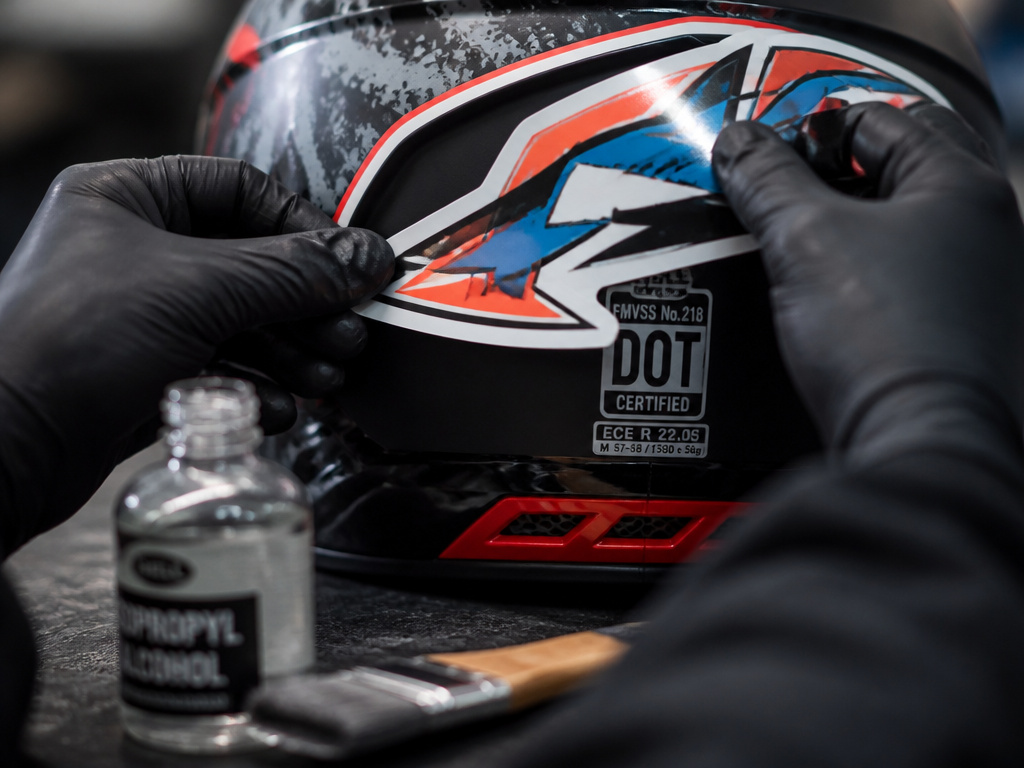
The certification is a snapshot of a new, unaltered product. The Leatt documents are relentless on this point. From a helmet file: “The protection of this helmet may be severely reduced by the application of paint, adhesive stickers or transfers, cleaning fluids or other solvents.”
From a protector manual: “Never use cleaners or detergents, or launder the protector, the product will be damaged by the cleaning process.”
You can’t see this damage. The EPS liner in a helmet can become brittle from solvent fumes without changing color. The plastic of a back protector can weaken from detergent residue. The how to read a motorcycle gear safety label promise expires the moment you deviate from the care instructions. This turns the care symbols from laundry advice into a maintenance log for your safety.
When checking a label for an airbag vest or integrated airbag system, look for a clear reference to this standard. A certified product will list it alongside the CE mark and the European regulation (EU) 2016/425. The label should state the specific performance level the airbag system has been tested to meet. Always verify that the certification applies to the product in its supplied configuration, as protectors are only certified when present inside the garment as supplied by the manufacturer.
This standard defines different classes of protection based on risk zones, from high to low risk. The EN 17092 series is comprised of several parts that specify requirements for each class of garment. A label referencing EN 17092 indicates a garment certified for general motorcycle use, while EN 13595 is for professional rider clothing. Always check which specific standard is listed to understand the intended use.
Frequently Asked Questions
What is the 2 2 2 rule for motorcycle helmets?
However, this conflicts with manufacturer data. Brands like Leatt provide condition-based or fixed-time advice in their manuals, not this specific rule. Always check your helmet’s actual manual.
What is the difference between CE Level 1 and Level 2 armor?
CE Level 1 and Level 2 refer to impact energy absorption under standards like EN 1621-2 for back protectors. A Level 1 protector can transmit an average of up to 18 kilonewtons (kN) of force from an impact, with no single strike exceeding 24 kN. A Level 2 protector is stricter, transmitting an average of ≤9 kN and a maximum of ≤12 kN. Level 2 is about twice as protective but is typically stiffer, heavier, and less flexible.
Can I add better armor to a certified jacket?
Maybe, but you likely void the garment’s certification. Leatt’s documentation states its protectors are “only certified when present inside your garment as supplied/configured by Leatt.” Third-party armor may not fit the pocket correctly, altering its position and performance. The jacket’s original rating no longer applies if you swap armor.
Is gear with just a CE mark (no EN number) safe?
No. A standalone CE mark can be a manufacturer’s self-declaration for general product safety (like no harmful dyes). For motorcycle gear, you must see the CE mark alongside a relevant EN standard number (e.g., EN 17092, EN 1621-1). This combination confirms it was tested as personal protective equipment for motorcycle use.
How do I know if my old gear is still safe?
Follow the stricter of two rules: the manufacturer’s stated lifespan (e.g., Leatt’s 3-year rule for protectors) and a thorough condition check. Look for faded or brittle fabric, cracked or deformed armor, loose seams, and compromised closures. If the gear has been in a crash, retire it, even if no damage is visible, the energy-absorbing materials may be spent.
Before You Go
Reading a label isn’t about memorizing codes. It’s about verifying a claim. The EN 17092-AA on a jacket tag is a promise that the fabric in the elbows and shoulders survived a specific abrasion test. Your job is to make sure that promise is for the kind of riding you do.
So here’s your field test. The next time you’re looking at gear, online or in a shop, run the five-step checklist. Find the CE and regulation number. Decode the EN standard and its class. Then, look for the warning no one reads, the one about “non-automotive use” or “clean only with water.” That’s where the real information lives. The difference between a label and a lifeline is in those details.
